Beryllium validation
Beryllium metal is the natural companion benchmark to graphite: a coherent crystalline scatterer with a published ENDF/B-VIII.1 evaluation, a structure-dependent (+Sd) variant, and a measured cold-neutron total cross section to overlay. Unlike graphite it is only weakly anisotropic, which makes it the control case for the Debye-Waller argument: where graphite's \(W_c/W_{ab} \approx 6.6\) makes the first-order approximation fail by orders of magnitude at high momentum transfer, beryllium's near-isotropic displacement tensor lets the isotropic and directional treatments stay together. The beryllium phonon calculation is a representative VASP/PAW PBE calculation (4×4×3 supercell, finite-displacement force constants in phonopy) from the same workflow as the graphite calculation; it is a test case for the anisotropic methods, and, like every phonon calculation in this record, it is parameter-free, fitted to nothing, so the results on this page are method demonstrations rather than best-fit benchmarks. All comparisons are at 296 K.
Throughout this page, IRMA mode 2 is the thermal scattering law S(α,β) computed from the phonopy calculation with the exact coherent one-phonon term, IRMA mode 1 is its incoherent-approximation counterpart, and Euphonic n = 1 is the independent coherent one-phonon reference on the same phonon calculation. OCLIMAX MAXO=1/100 are OCLIMAX runs truncated at multiphonon order 1 or 100; at MAXO=1 both the released code and the unreleased full-tensor Debye-Waller build appear, as for graphite. ENDF/B-VIII.1 beryllium-metal and Be+Sd are the released evaluations, built from phonon calculations different from the one used here.
The coherent one-phonon term against Euphonic and OCLIMAX
The classic kernels are verified on the reference set of the methodology page (graphite, iron, aluminum, polyethylene, and the fresh-tape materials); beryllium enters at the directional rungs of the ladder. The comparison is set up exactly as for graphite: the coherent part of the n = 1 term on the same phonon calculation, OCLIMAX keeping only the coherent part by zeroing the incoherent cross sections in its material file, in both the released and full-tensor Debye-Waller variants, and Euphonic evaluated at the IRMA (α, β) grid, with no regridding or broadening.
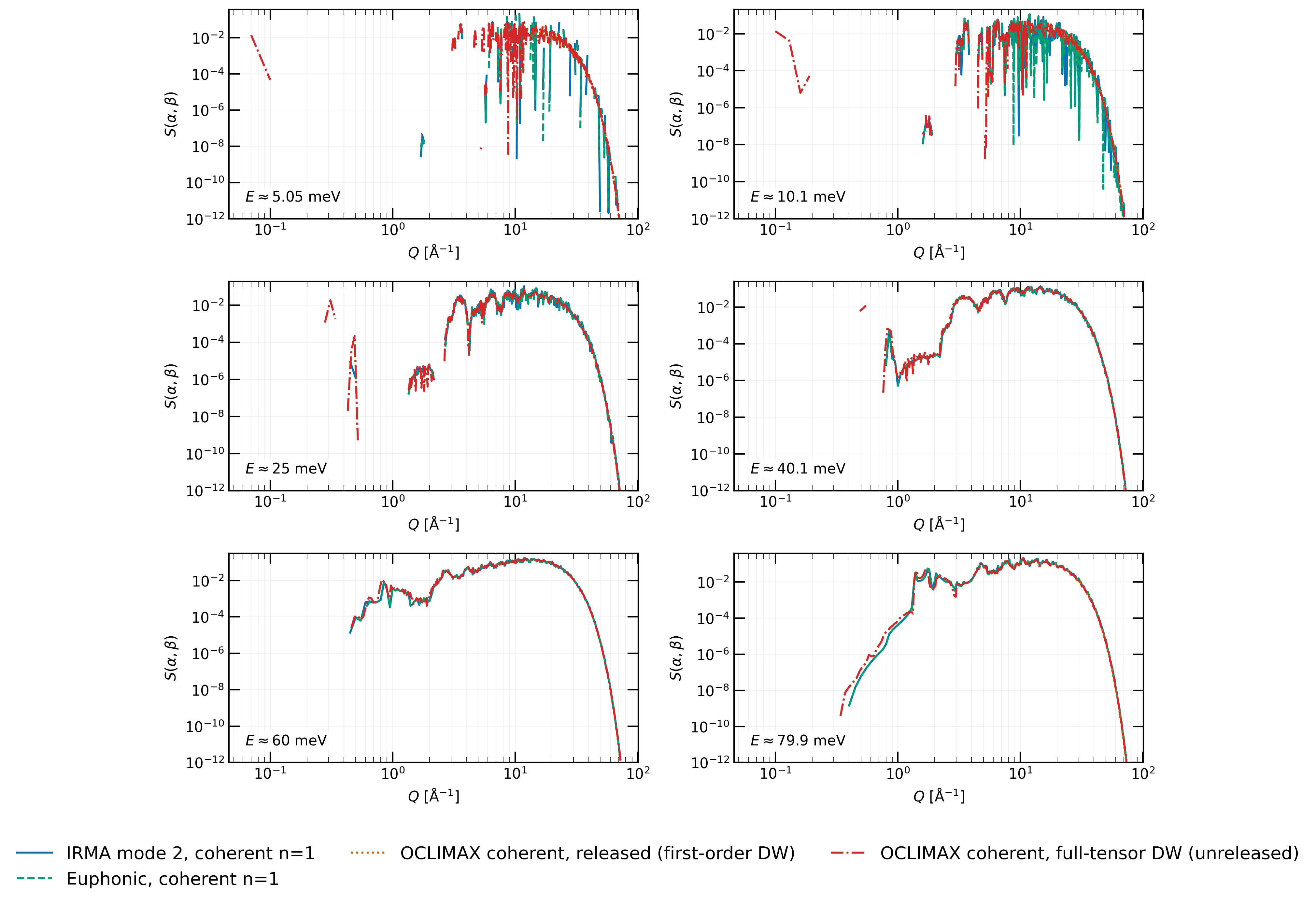
Fixed-energy cuts through the coherent one-phonon (n = 1) S(α,β) at 296 K: IRMA mode 2 (coherent component), Euphonic, and OCLIMAX with the incoherent cross sections set to zero, in the released and full-tensor variants; each curve at the nearest energy of its own tabulated grid.
All four coherent curves stay together at every Q. This is the control side of the Debye-Waller argument: in nearly isotropic beryllium the first-order approximation costs nothing, the released and full-tensor variants coincide, and the graphite divergence therefore comes from the anisotropy rather than from any code's implementation of the coherent term. The shared-domain integral ratio against Euphonic is 1.0002, with a median difference of 0.005% in the energy integral J(Q) = ∫ S(Q,E) dE over Q ≤ 20 Å⁻¹; against OCLIMAX the coherent ratio is 0.99 with either variant.
The full one-phonon term and its components
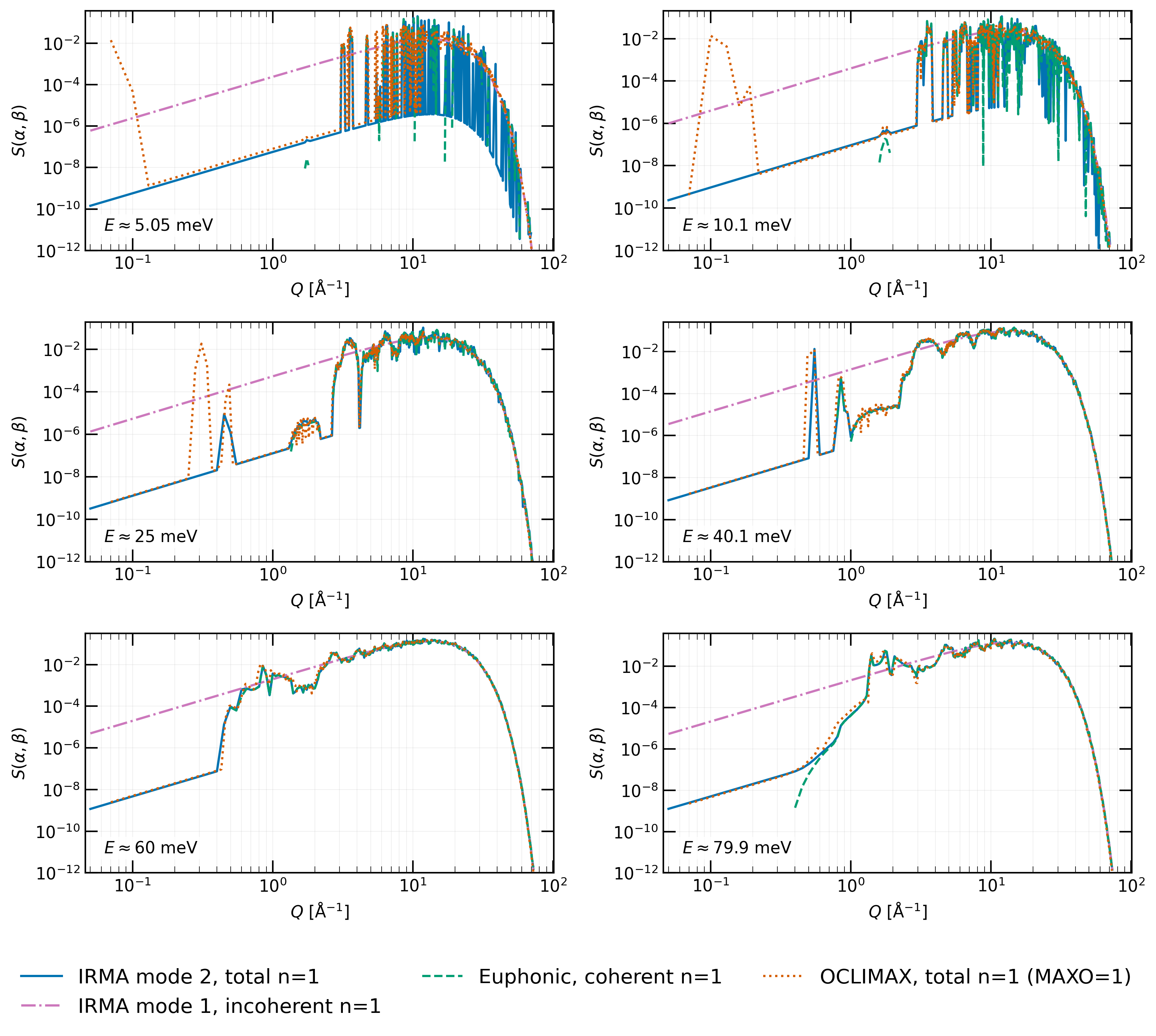
Raw fixed-energy cuts through the beryllium n = 1 S(α,β) tables at 296 K. Euphonic carries only the coherent one-phonon term; IRMA mode 2 and OCLIMAX MAXO=1 carry both one-phonon components; IRMA mode 1 is the incoherent counterpart.
The full S(α,β) against OCLIMAX and the released evaluations
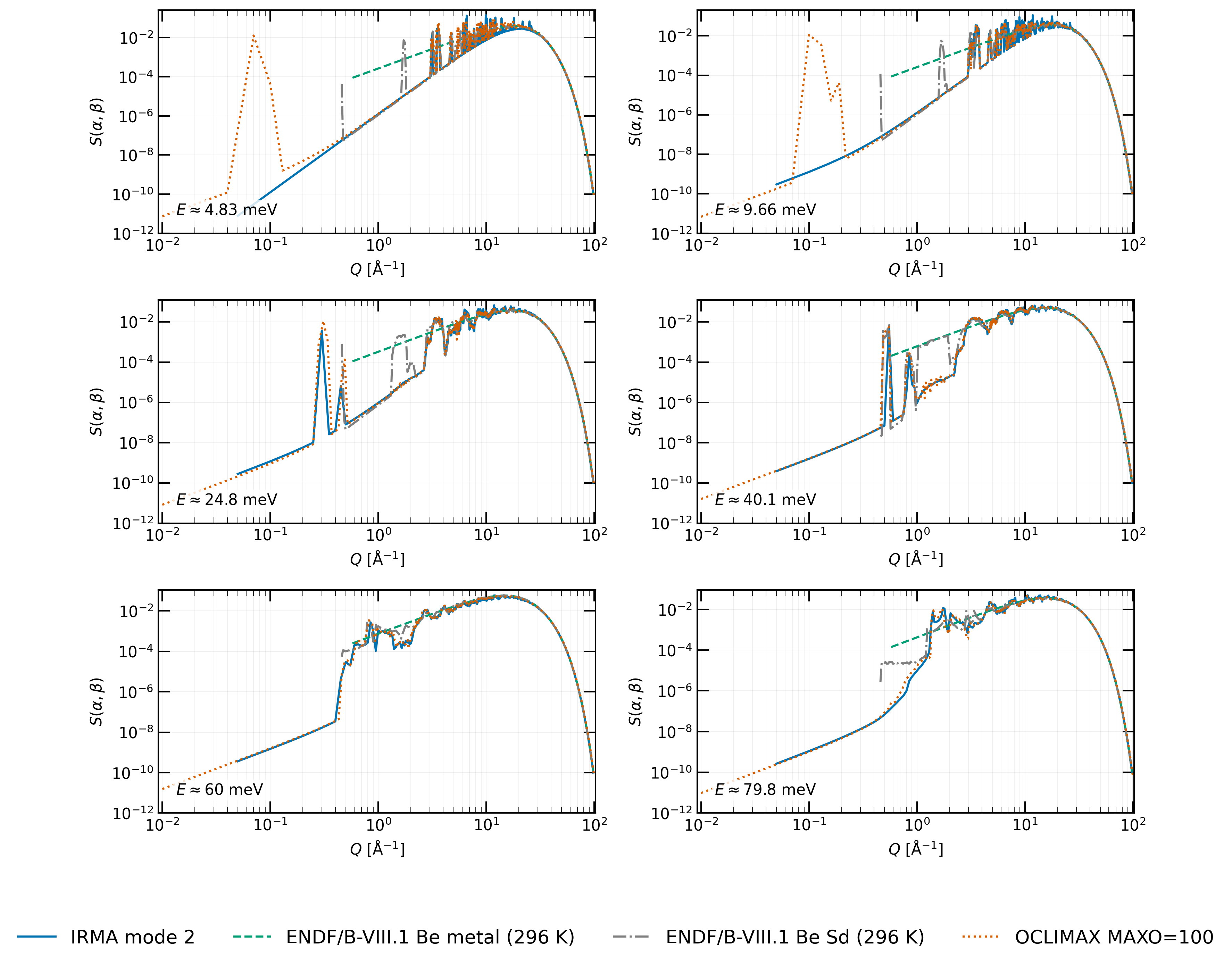
The full beryllium mode-2 S(α,β) (symmetric form) at 296 K, compared with OCLIMAX (MAXO=100) and the ENDF/B-VIII.1 beryllium-metal and Be+Sd evaluations, both built from phonon calculations different from the one used here.
Both codes were run to the same multiphonon order, and the shared-window integrals of the symmetric tables agree to about 2% (R = 0.98). The agreement is also uniform: cut by cut, the two stay within about 2% at every Q, since with no strong anisotropy, no residual accumulates in the high-Q multiphonon tail as it does for graphite. The Be+Sd file contains narrow spikes near Q ≈ 0.5, 1.8, and 3 Å⁻¹ that neither the IRMA nor the OCLIMAX calculation contains; as for the graphite Sd structure, the origin of this structure in the evaluation is not established here.
Processed cross sections and the measured cold-region total
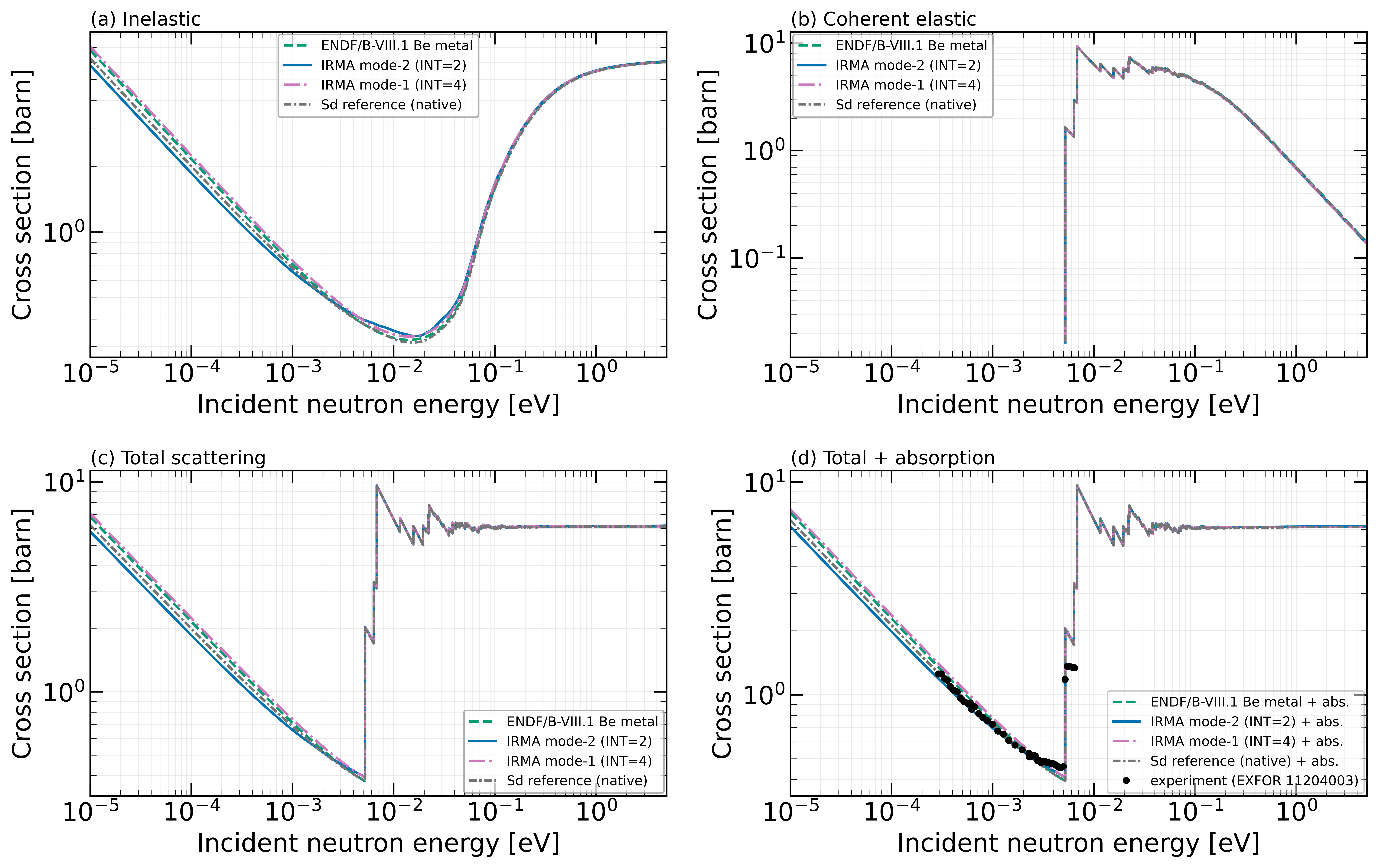
Beryllium cross sections at 296 K, with the NJOY processing and interpolation conventions of the graphite page: IRMA mode 2 and mode 1 against the ENDF/B-VIII.1 beryllium-metal and Be+Sd evaluations. Panels: inelastic, coherent elastic, total scattering, and total-plus-absorption with the measured cold-region total (EXFOR 11204003).
Both directional modes follow the evaluations through the inelastic, coherent-elastic, and total panels, and below the Bragg cutoff the calculated total-plus-absorption passes through the measured cold-region points. Lin-lin interpolation shifts the beryllium thermal features by about 2–5%, smaller than for graphite because its coherent near-zeros are shallower. EXFOR 11204003 is tabulated without per-point uncertainties, so the measured total is shown as points without error bars.
Crystalline extinction
Beryllium is also the verification case for the opt-in
crystalline extinction correction. Extinction is
the reduction of Bragg intensity in a real crystallite: once a beam is
strongly Bragg-scattered it is depleted before it can scatter again, so
measured peaks fall below the ideal kinematic values (the
extinction page has the physics). The models are
ported from the NCrystal CrysXT plugin (D. D. DiJulio), which implements
the Kittelmann et al. recipes (references on the extinction page). The port was verified in two stages. At the kernel
level, IRMA reproduces CrysXT within rounding (0.000%) for nine reference
cases spanning the five extinction models; the frozen cases are regression
references, so the test requires neither NCrystal nor CrysXT at test time.
At the evaluation level, with the unit cell matched to the reference
structure, a beryllium iel=10 evaluation written by IRMA and run through
NJOY processing agrees with the CrysXT coherent-elastic cross section to a
median of 0.07%; this second comparison tests the processed MF7/MT2
histogram rather than only the analytic kernels.
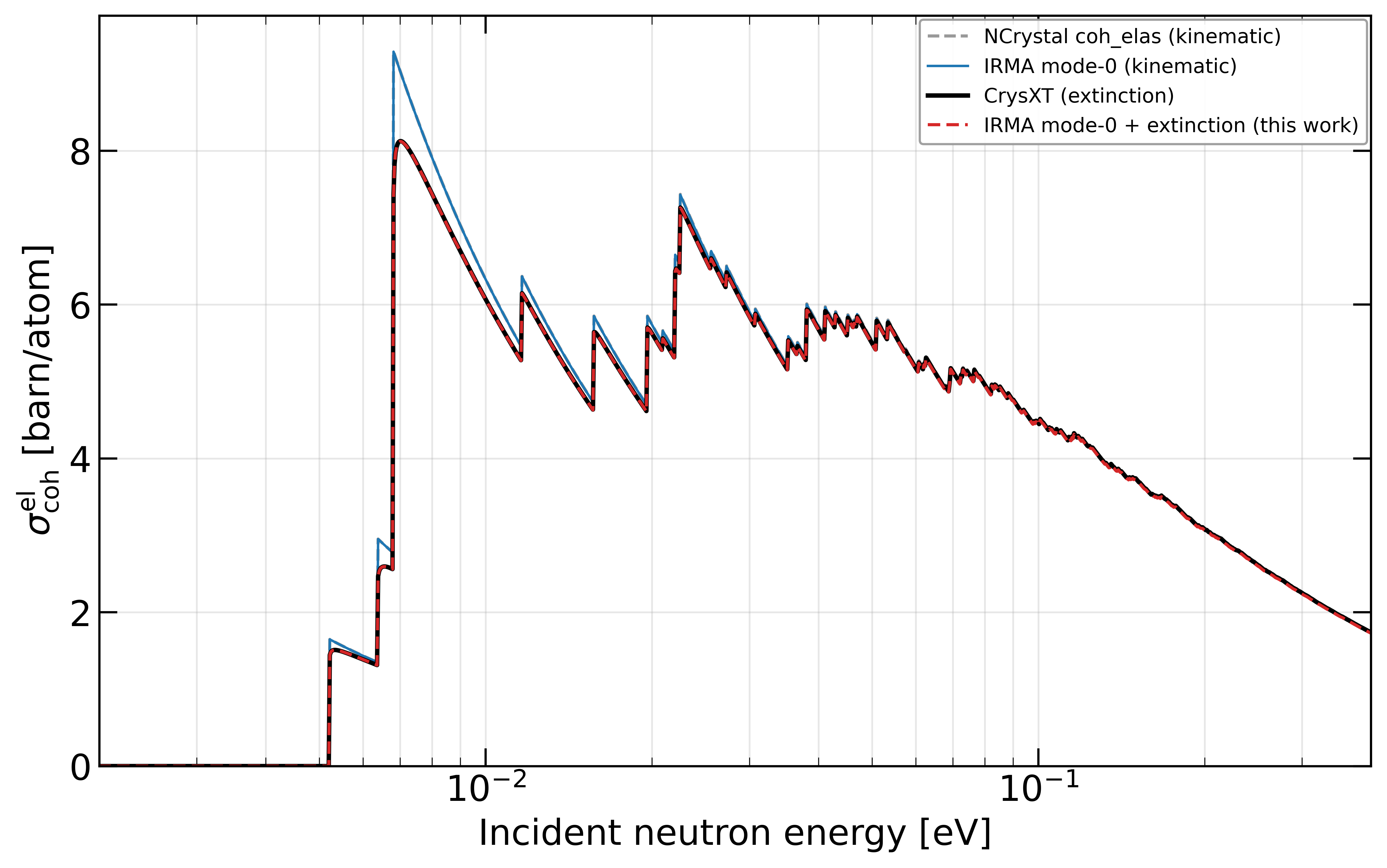
Coherent-elastic cross section per atom for beryllium with and without
crystalline extinction. The kinematic curves are from NCrystal and IRMA
mode 0; the extinction-corrected curves use the Becker-Coppens BC_mix
model in CrysXT and IRMA, for a specimen with crystallite size 0.855 μm,
mosaic parameter 170 rad⁻¹ (the Becker-Coppens mosaic-distribution
parameter, an inverse angular width), and grain size 7.58 μm. The
parameters demonstrate the models; they were not fitted to the
transmission data shown above.
For these specimen parameters, extinction reduces the kinematic Bragg intensity by up to about 20% at the lowest energies; the correction falls below the tabulation tolerance above approximately 0.1 eV and does not alter the inelastic component. In the measured cold-region comparison above, the ideal-crystal calculation jumps to the full kinematic Bragg pattern at the cutoff, while measured transmission data from real specimens can rise less sharply; both extinction and instrument resolution suppress the sharp edge. Fitting the extinction parameters to a measured transmission (as in Xu et al. 2025, cited on the extinction page) is exactly the use case this correction serves.
What the beryllium suite establishes
The directional one-phonon term agrees with Euphonic to a shared-domain integral ratio of 1.0002 (median J(Q) difference 0.005%), and the coherent comparison with OCLIMAX gives 0.99 with either Debye-Waller variant. The full S(α,β) tracks order-matched OCLIMAX to 2%, uniformly in Q, and the processed cross sections follow the released evaluations and pass through the measured cold-region total below the Bragg cutoff. The extinction port is verified to 0.000% at the kernel level and to a median of 0.07% through the full evaluation chain. Just as important, beryllium completes the graphite Debye-Waller argument: a nearly isotropic crystal is where the first-order approximation is supposed to hold, and here it does.