Beryllium oxide validation
Beryllium oxide is the validation suite's polyatomic benchmark. Graphite and beryllium are single-element crystals, so the thermal scattering law S(α,β) of each is a single MF7/MT4 section; BeO has two principal scatterers (beryllium and oxygen), and the material S(α,β) is the sum of a Be-in-BeO evaluation and an O-in-BeO evaluation. BeO therefore exercises IRMA's per-principal partition of the coherent one-phonon interference and the recombination into a material S(α,β), on top of the directional Debye-Waller physics established for graphite. The BeO phonon calculation is a representative VASP/PAW PBE calculation (4×4×3 supercell) from the same workflow as the graphite calculation, a test case for the polyatomic methods rather than one optimized against experiment. IRMA results are at 296 K; the released ENDF/B-VIII.1 evaluation is tabulated at 293.6 K.
Throughout this page, IRMA mode 2 (material) is the scattering-cross-section-weighted material S(α,β) formed from the beryllium and oxygen principal evaluations, and IRMA mode 1 is its incoherent-approximation counterpart. OCLIMAX is a single whole-cell calculation (it does not partition per principal scatterer), truncated at MAXO=1 or 100. ENDF/B-VIII.1 BeO is the released evaluation at 293.6 K, built from a different phonon calculation and without the distinct (+Sd) effect. Euphonic (material) is the whole-cell coherent one-phonon reference on the same phonon calculation, in the beryllium-principal convention.
A whole-cell OCLIMAX or Euphonic S(α,β) carries the Be-O interference term and cannot be split into a Be-only and an O-only contribution without a partition rule. Whole-cell references are therefore always compared against the sum of IRMA's two principal evaluations, never against a single principal in isolation.
Verifying the polyatomic partition
IRMA writes BeO as two principal evaluations, one carried by beryllium and one by oxygen. As a reference, the same phonon calculation was also run through IRMA in a single whole-cell configuration, which computes the complete material S(α,β) directly and partitions nothing; the check therefore verifies the partition's internal consistency, not agreement with an independent code. The weighted sum of the two principal evaluations reproduces this whole-cell result to about 10⁻¹⁵ at every grid point, and the interference reconstructed from the two written evaluations matches the directly computed interference to 3.4×10⁻¹⁵.
The quantity being divided is the cross-species interference, which belongs to the material rather than to either atom, so its assignment to the principal evaluations is purely conventional, and the summed material S(α,β) does not depend on this choice. The runs on this page gave each pair term to the two species in proportion to their coherent cross sections (64.3% beryllium, 35.7% oxygen). Since IRMA 1.1.0 each species gets the fraction |F_p|² / Σ_g |F_g|² of the total for each mode instead, which keeps every share non-negative; the earlier split had cells below zero that the tables could not hold. The interference is locally significant but integrally small: its magnitude amounts to about 10% of the coherent one-phonon intensity, yet its positive and negative regions nearly cancel: the signed sum over Q ≤ 40 Å⁻¹ and E ≤ 150 meV amounts to only −0.044% of the coherent one-phonon integral over the same window.
The coherent one-phonon term against Euphonic and OCLIMAX
The coherent comparison for BeO is made in the beryllium-principal convention: α is computed with the beryllium mass ratio and the result is normalized per atom, so whole-cell references can be overlaid on the sum of IRMA's principal components. The Euphonic reference was regenerated for a one-to-one comparison, with the same golden-spiral powder sampling (10000 directions), the same 40³ Debye-Waller mesh, and the material per-atom normalization. The scattering-cross-section-weighted sum of IRMA's beryllium and oxygen coherent components matches the Euphonic whole-cell calculation to a shared-domain integral ratio of 0.9998, which validates the per-species partition against a code that never partitions. Against whole-cell OCLIMAX with the incoherent cross sections zeroed, the coherent ratio is 0.99 with either Debye-Waller variant, as for beryllium: BeO is nearly isotropic, so the first-order and full-tensor treatments agree.
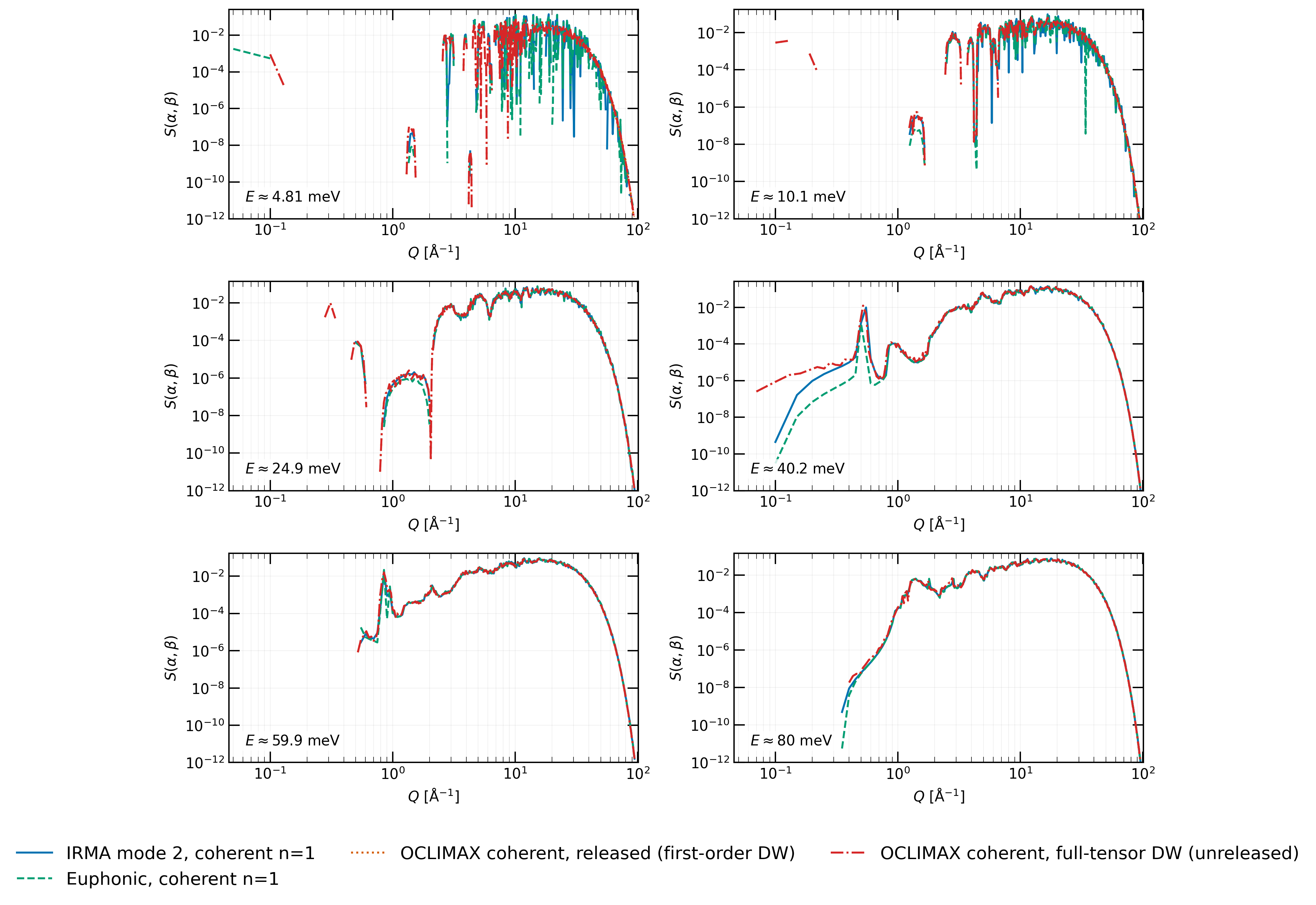
Fixed-energy cuts through the coherent one-phonon (n = 1) S(α,β) at 296 K, in the beryllium-principal material convention: the IRMA mode-2 material component (the σ-weighted sum of the beryllium and oxygen principal components), the Euphonic whole-cell calculation, and OCLIMAX with the incoherent cross sections set to zero, in the released (first-order Debye-Waller) and unreleased full-tensor variants; each curve at the nearest energy of its own tabulated grid.
The full S(α,β) against OCLIMAX and the released evaluation
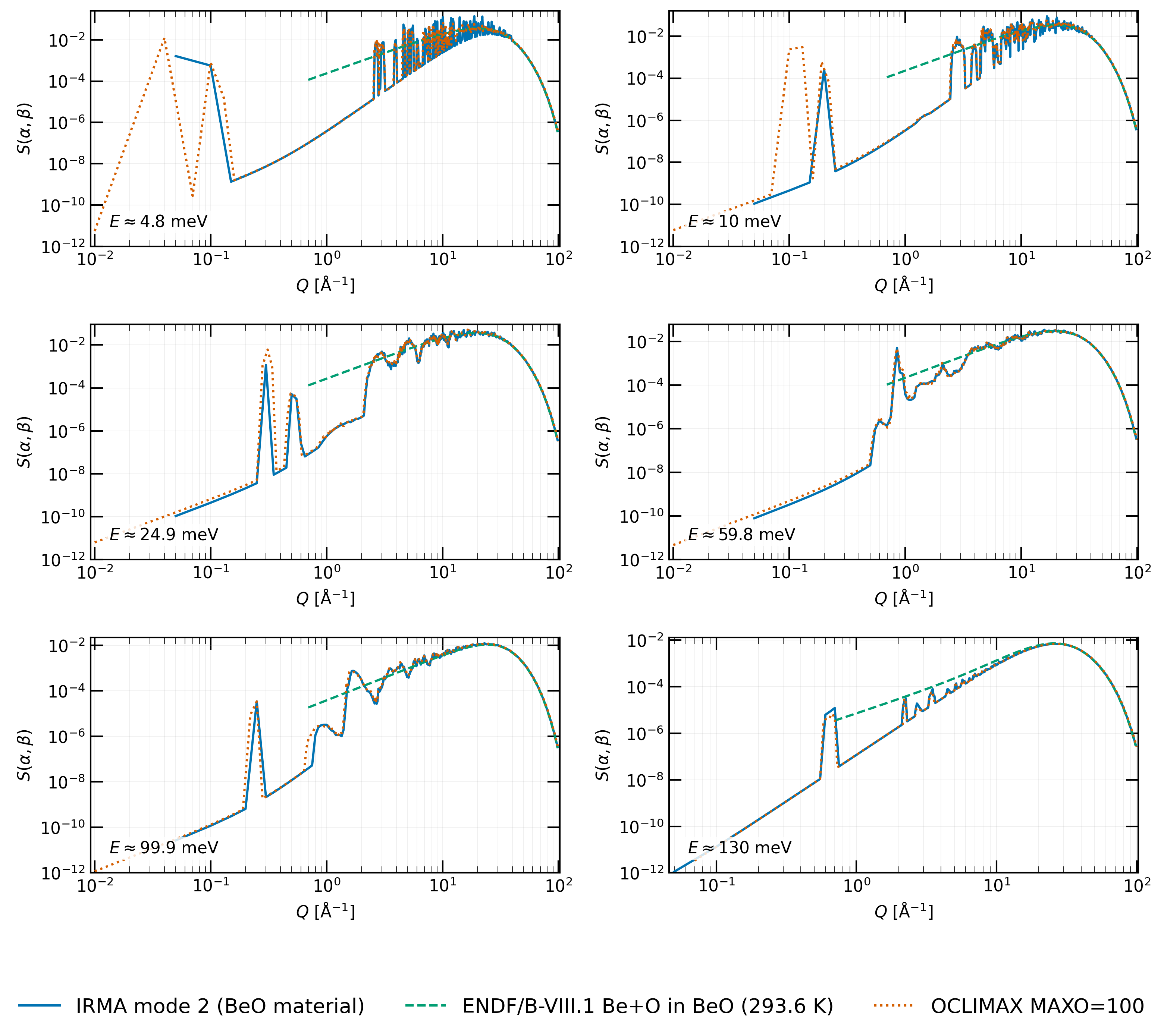
The full BeO mode-2 S(α,β) (symmetric form) at 296 K. The scattering-cross-section-weighted material result formed from the beryllium and oxygen principal evaluations is compared with the OCLIMAX whole-cell result and the ENDF/B-VIII.1 BeO evaluation at 293.6 K. OCLIMAX starts from the same phonon calculation as IRMA; the evaluation was built from a different one.
Both codes were run to the same multiphonon order, and the shared-window integral ratio of the symmetric tables against whole-cell OCLIMAX is 0.99. The released evaluation, built from a different phonon calculation, still integrates to within 0.1% of IRMA mode 2 over the full window; that is expected of any properly normalized S(α,β), because over the full window the integral measures only the overall normalization. No integral ratio is therefore quoted against evaluations; the differences are read from the pointwise structure and the processed cross sections instead.
Processed cross sections
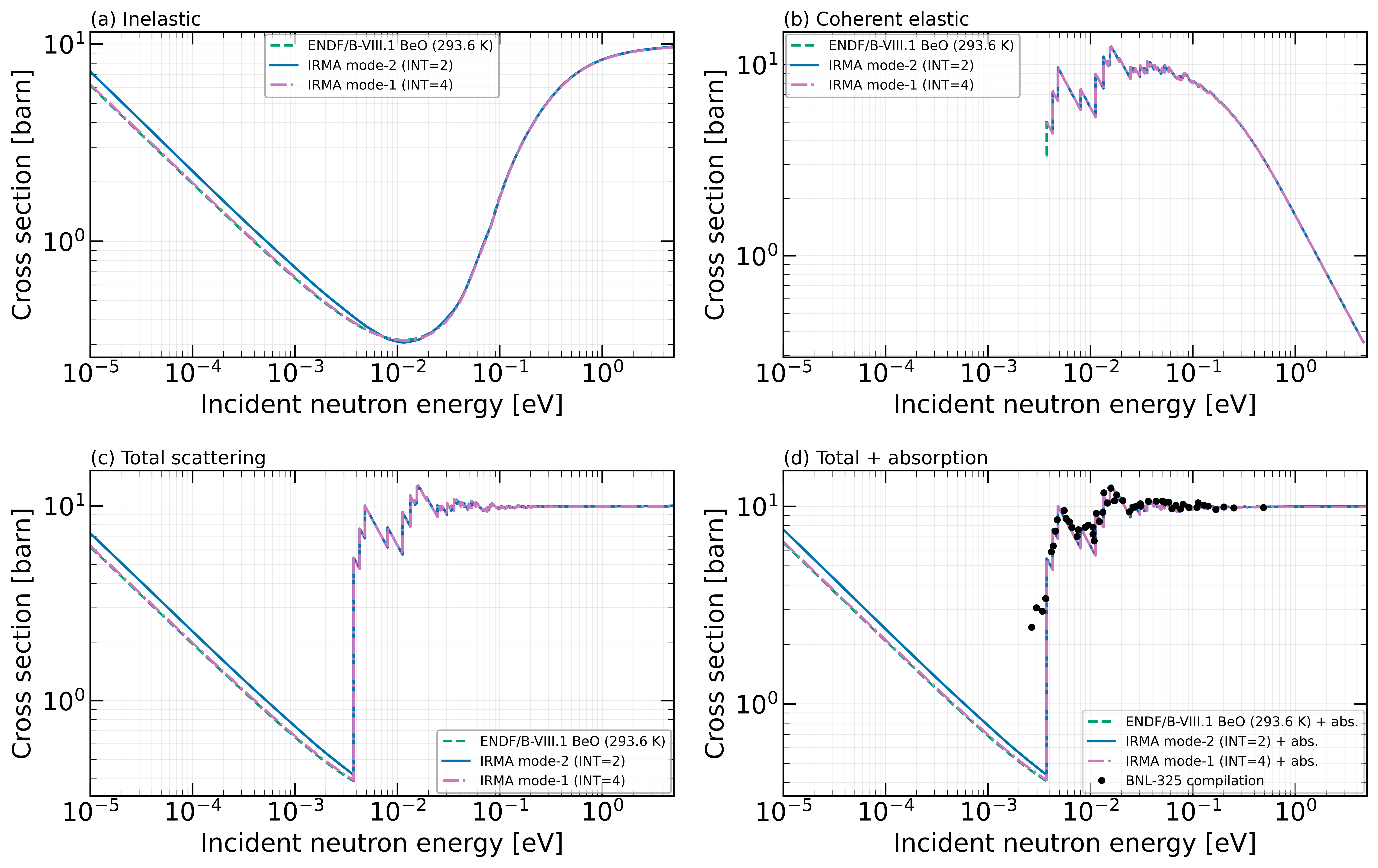
BeO cross sections from NJOY processing, formed as the sum of the processed beryllium and oxygen principal cross sections, with the interpolation conventions of the graphite page: IRMA mode 2 and mode 1 at 296 K against the ENDF/B-VIII.1 BeO evaluation at 293.6 K. Panels: inelastic, coherent elastic, total scattering, and total-plus-absorption, the last with the measured BeO total from the BNL-325 compilation (black points, barn per BeO formula unit).
The BeO ENDF/B-VIII.1 evaluation does not include the distinct effect, so its component counterpart is mode 1, which stays within about 1.3% of the evaluation below 2.3 meV; mode 2, adding the coherent one-phonon term absent from the evaluation, is higher there by about 10–16%. The measured total from the BNL-325 compilation is overlaid for qualitative comparison with the Bragg-edge structure and the thermal total. Lin-lin interpolation shifts the BeO thermal features by about 2–5%, smaller than for graphite because the coherent near-zeros are shallower.
Elastic output formats: SEF and MEF
The polyatomic elastic bookkeeping has two output conventions, selected on Card 6b: the single-channel elastic format (SEF; LTHR=1 for the coherent-carrier cases here) and the mixed elastic format (MEF, LTHR=3); see the elastic-format rules. For BeO itself the two formats sum to the same material cross section, so no BeO measurement can tell them apart; the discriminating test borrows nickel. With σ_coh = 13.3 b and σ_inc = 5.2 b nickel is a mixed elastic scatterer, the situation MEF was introduced for, and the formats separate below its first Bragg edge.
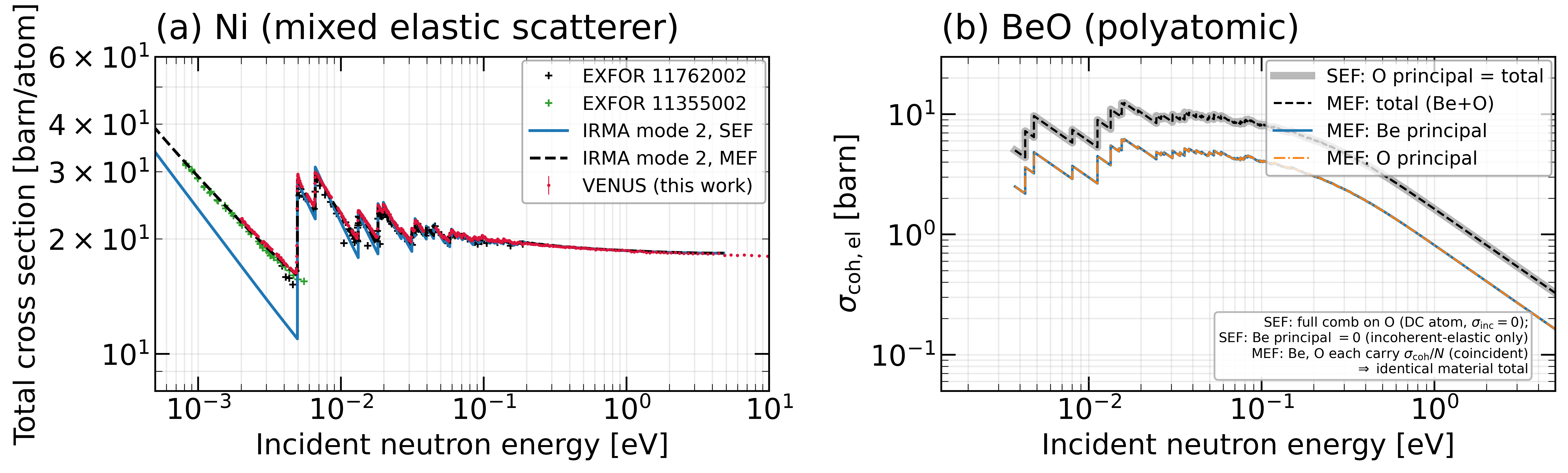
The SEF and MEF elastic formats. (a) Nickel total cross section per atom at 299.15 K: EXFOR datasets 11762002 and 11355002, the VENUS nickel measurement, and IRMA mode-2 evaluations from one ferromagnetic DFT phonon calculation shared by both formats, processed through NJOY THERMR with natural-nickel absorption added. (b) For BeO, the two formats split the same Bragg-edge sum differently between the principal evaluations; the summed material cross section is unchanged.
Above the first Bragg edge both formats follow the measured Bragg structure equally well, with median calculated-to-measured ratios against the VENUS points of 0.987 (SEF) and 0.996 (MEF) between 5.2 meV and 4.5 eV; the two distribute the elastic strength differently around the low-energy Bragg structure (SEF scales the coherent edges, MEF adds a smooth incoherent term) and converge above 0.1 eV. Below the edge they separate: SEF carries the entire elastic strength in the coherent term, and coherent elastic scattering does not exist below the first-edge cutoff, so its total falls 27% under the measured points (median ratio 0.731 between 2 and 4.5 meV), while MEF retains the incoherent-elastic term and stays on the data (median ratio 0.985).
For BeO, the formats differ in their per-species assignment. SEF places the complete Bragg-edge sum on the oxygen principal, the designated-coherent atom of the selection rule (the species with the smallest incoherent contribution; beryllium is actually the stronger coherent scatterer, with b_coh = 7.79 fm against 5.80 fm for oxygen, but oxygen's near-zero σ_inc makes it the designated carrier), and assigns the beryllium principal an incoherent-elastic term that carries the redistributed remainder. MEF divides the per-atom Bragg-edge sum equally between the two principal evaluations. The summed BeO material cross section agrees between the formats to 5×10⁻⁷; only its representation among the principal evaluations changes.
What the beryllium-oxide suite establishes
The per-principal partition is verified against a direct whole-cell calculation to about 10⁻¹⁵, with the conventionally assigned interference integrally negligible (−0.044% signed sum). The recombined material S(α,β) matches whole-cell OCLIMAX to 1% (R = 0.99), and the processed material cross section tracks the released evaluation, with the expected component-bookkeeping difference below 2.3 meV (mode 1 within 1.3% of the evaluation, mode 2 higher by the coherent one-phonon term the evaluation omits) and the BNL-325 measured total overlaid for qualitative comparison. The SEF/MEF comparison, discriminated by the nickel transmission measurement, shows the two elastic formats equivalent above the first Bragg edge and MEF the faithful representation below it for mixed elastic scatterers; for BeO the choice only redistributes the same material cross section between the principal evaluations. BeO thereby extends the validation from single-element crystals to a polyatomic compound: it exercises the per-principal accumulation and material recombination that any multi-element evaluation depends on.