Scattering modes
IRMA describes a material's thermal response with three choices: which
coherent-elastic treatment to use (iel), which elastic format to write
(elastic_mode), and which inelastic engine to run (inelastic_mode).
S(α,β) is the thermal scattering law in the dimensionless momentum and
energy transfer; the theory page defines it and the conventions
used here. The selectors live on different cards (the numbered records of
the LEAPR-style input file; see the input file reference).
iel is set on Card 5. When iel=10, Card 6b adds the other two selectors,
elastic_mode and inelastic_mode, which can be combined in any way. This
page describes each selector, shows how to read them off an input file, and
gives guidance for picking the right combination for cubic versus noncubic
and isotropic versus anisotropic materials.
The three axes at a glance
| Axis | Card / field | What it controls | Values |
|---|---|---|---|
iel |
Card 5, field 4 | Coherent-elastic (Bragg) treatment | 0 none/incoherent; 1–6 built-in materials; 10 generalized (any crystal) |
elastic_mode |
Card 6b, field 1 (iel=10 only) |
ENDF elastic format written | 1 = SEF (single-channel elastic format); 2 = MEF |
inelastic_mode |
Card 6b, field 4 (iel=10 only) |
Inelastic S(α,β) engine | 0 phonon expansion from a DOS; 1 directional incoherent; 2 coherent one-phonon |
elastic_mode and inelastic_mode live on Card 6b, which is present only
when iel=10. For the built-in materials (iel=1–6) and for iel=0,
IRMA uses the classic kernels and the two Card 6b selectors do not apply.
Axis 1 (iel): coherent-elastic treatment
iel (Card 5, field 4) selects how Bragg (coherent-elastic) scattering is
handled.
iel |
Treatment | Notes |
|---|---|---|
0 |
None / incoherent | No coherent elastic; with no translational mode IRMA flags incoherent elastic |
1–6 |
Built-in coherent elastic | Graphite, Be, BeO, Al, Pb, Fe (in that order) |
10 |
Generalized | Bragg edges computed from the crystal structure you supply on Cards 6c–6d; works for any material |
The built-in options reproduce the crystal tables of LEAPR's historical
coher routine.
iel=10 is recommended for new evaluations: it computes Bragg
edges directly from your unit cell and unlocks the elastic_mode and
inelastic_mode axes.
The generalized path also changes what the Card 4 za must contain. With
iel=10, za must encode the physical nuclide as 1000·Z + A (with
A = 0 for the natural element) so that
the principal scatterer can be matched to a Card 6d atom type. Some
thermal libraries use a TSL-convention ZA instead; that convention will
not match here.
Axis 2 (elastic_mode): which elastic format to write
elastic_mode (Card 6b, field 1) is only meaningful when iel=10. It
selects the ENDF elastic representation and therefore the LTHR flag your
downstream codes will see.
elastic_mode |
Name | What is written | Resulting LTHR |
|---|---|---|---|
1 |
SEF (single-channel elastic format) | One elastic component per tape (each species' tape), scaled to carry the total bound elastic scattering (mechanism below) | 1 (coherent) or 2 (incoherent), per species |
2 |
MEF (Mixed Elastic Format) | Every atom gets both a coherent (per-atom Bragg edges) and an incoherent part | 3 (mixed) |
For a single-atom material under SEF, the component with the larger bound cross section, coherent or incoherent, is kept and scaled to carry the total bound scattering cross section. For a polyatomic cell, SEF selects one designated-coherent (DC) atom, the one minimizing the incoherent contribution; that species' tape (ENDF output file) carries the coherent elastic, and the others carry incoherent elastic with a redistribution factor. The scaling has a physical consequence for coherent-kept materials: coherent elastic scattering does not exist below the first Bragg edge, so the SEF elastic cross section is zero there. MEF carries the incoherent component separately and does not have this gap.
MEF needs downstream support:
elastic_mode=2 writes LTHR=3, so confirm that your transport and
processing chain understands the mixed elastic format before choosing it.
When in doubt, SEF (elastic_mode=1) is the conservative, widely
supported choice.
Axis 3 (inelastic_mode): the S(α,β) engine
inelastic_mode (Card 6b, field 4, iel=10 only) chooses how the
inelastic S(α,β) is built.
inelastic_mode |
Engine | Debye-Waller | Needs phonopy? | Reads the DOS cards? |
|---|---|---|---|---|
0 |
Phonon expansion from a tabulated DOS | Isotropic (scalar) | No | Yes (Cards 11–19, with Card 12e) |
1 |
Directional incoherent approximation | Directional | Yes | No |
2 |
Exact coherent + incoherent one-phonon, incoherent multiphonon | Directional | Yes | No |
inelastic_mode=0 is the classic LEAPR physics level: an isotropic
Debye-Waller factor and a phonon expansion built from a scalar phonon
density of states given in the input file, with no phonopy required.
inelastic_mode=1 computes a directional Debye-Waller factor for the
coherent elastic and an S(α,β) computed in-process from the phonopy calculation, using an
incoherent-approximation one-phonon term plus incoherent-approximation
multiphonons. inelastic_mode=2 is the same as mode 1 except that the
one-phonon term is exact (coherent plus incoherent) on top of the
incoherent-approximation multiphonons.
In modes 1 and 2 the one-phonon term comes from the phonon modes of the phonopy q-mesh, so it is zero for energy transfers below the lowest kept mesh-mode energy; a finer mesh reaches lower. The run prints that energy and the number of output energies below it.
Even in mode 2, only the one-phonon term is coherent. The multiphonon
orders (n ≥ 2) use the incoherent-approximation model (a per-atom self
kernel scaled by the atom's total scattering cross section), so coherent
interference is dropped in the tail. The engine records
multiphonon_model = "incoherent_approximation" in its run metadata (the
standalone engine's JSON output and the spectra results' engine metadata);
ENDF tapes do not carry this label.
Modes 1 and 2 ignore the DOS cards.
inelastic_mode=1/2 build the inelastic section (MF7/MT4) and the Debye-Waller factors entirely from
the phonopy calculation: the continuous-DOS, translational, and
oscillator detail cards (Cards 11–19) are not read, and Card 12e partial
spectra are rejected (nspec must be 0). The input file supplies only the
temperature cards; everything else comes from phonopy. The mixed-moderator
(nss>0), cold-hydrogen (ncold), and Sköld (nsk) options are also
unavailable with modes 1/2 and are rejected at parse time.
What modes 1 and 2 require
When inelastic_mode=1 or 2, supply the phonopy mesh and sampling
controls between Cards 6d and 7:
- Card 6f: the
phonopy.yamlpath, thenmesh_nx mesh_ny mesh_nz ncpu use_born(and aBORNpath ifuse_born=1). Force constants are read from the yaml if embedded, otherwise discovered next to it (force_constants.hdf5,FORCE_CONSTANTS,FORCE_SETS, in that order). The process working directory is never consulted. - Card 6g: the powder-averaging sampling controls (next section).
These modes need the optional phonopy dependency:
pip install -e ".[phonopy]" # + the phonopy-backed modes (inelastic_mode=1/2)
Choosing a combination
Cubic vs noncubic materials
For a cubic material the Debye-Waller factor is isotropic by symmetry, so
inelastic_mode=0 (with a good DOS) captures the physics and is fast. For
a noncubic (anisotropic) crystal, the directional engines (1/2) are
the point of iel=10: they carry the full Debye-Waller tensor rather than
collapsing it to a scalar.
Isotropic vs directional Debye-Waller: why it matters
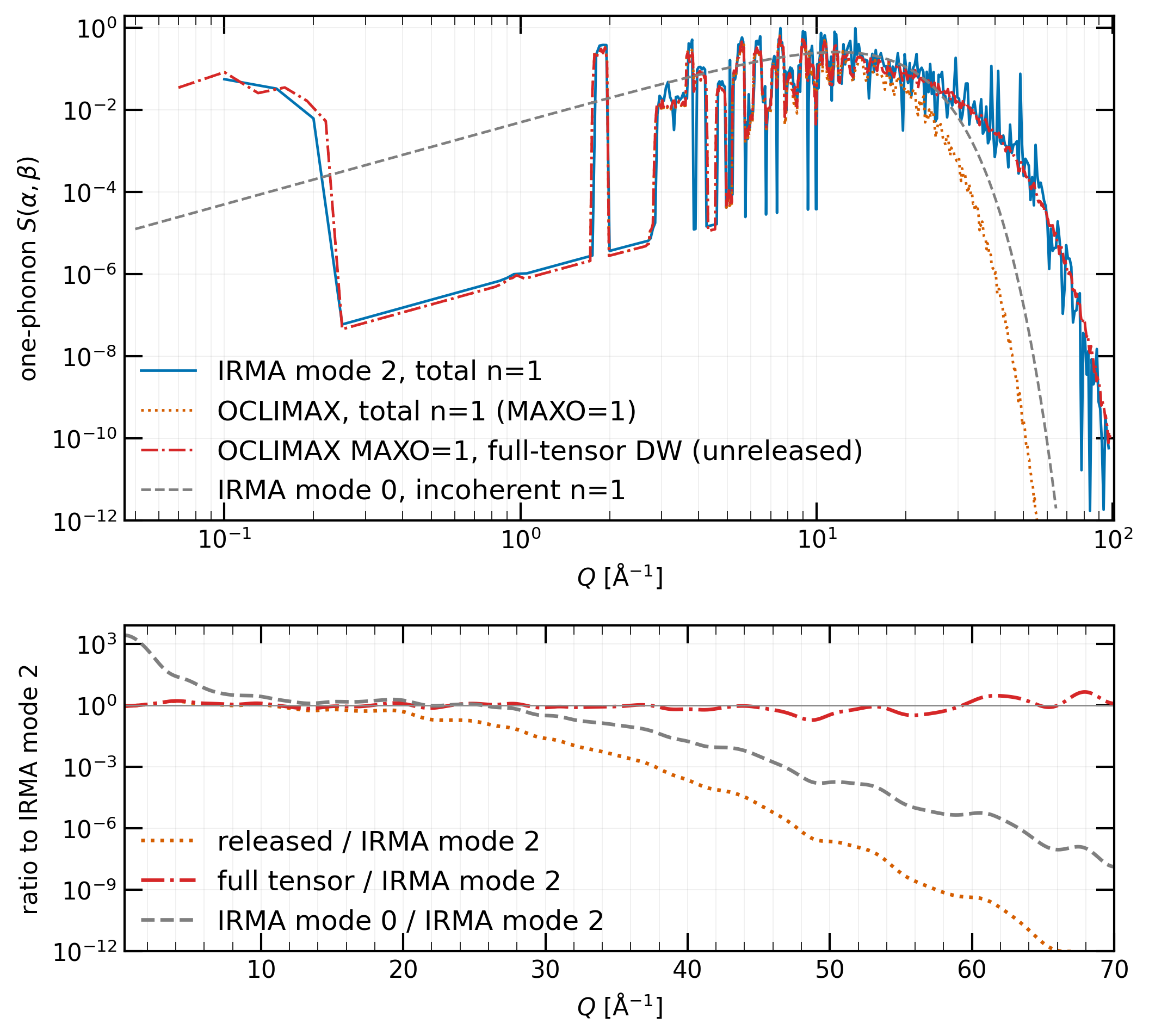
The Debye-Waller factor suppresses one-phonon scattering exponentially with momentum transfer Q. In an anisotropic crystal that suppression is direction-dependent, and the powder average of the exact directional factor is not the same as applying a single orientation-averaged (isotropic) factor.
In graphite, for example, the perpendicular and in-plane Debye-Waller
terms differ by roughly a factor of 6.6 (W_c / W_ab ≈ 6.6). An isotropic
treatment exponentially over-suppresses the one-phonon S(α,β) at high Q
relative to the exact directional powder average. IRMA's inelastic_mode=2
performs the directional powder average exactly; inelastic_mode=0
(isotropic Debye-Waller) on the same phonon calculation shows the
over-suppressed roll-off. Mode 0 also differs from mode 2 in the one-phonon
term itself, which it builds in the incoherent approximation from a scalar
DOS.
The exact one-phonon treatment is cross-validated against Euphonic, an
independent code run on the same phonon calculation, for graphite, Be,
and BeO: coherent component against coherent component, the integrals of
the symmetric S(α,β) agree to ratios of 1.00001 (graphite), 1.0002 (Be),
and 0.9998 (BeO).
For strongly anisotropic crystals, prefer inelastic_mode=2; reserve
inelastic_mode=0 for cubic materials or for reproducing existing isotropic
evaluations.
Card 6g: sampling controls
Card 6g (modes 1/2 only) sets the powder-averaging resolution and the multiphonon order:
ndir mpdir [auto_order] /
| Field | Name | Meaning |
|---|---|---|
| 1 | ndir |
One-phonon powder-average directions, for the coherent and the incoherent term (golden-spiral quadrature). Must be ≥ 1 |
| 2 | mpdir |
Multiphonon powder-average directions. Converges by about 50–100 directions; 1000 is recommended, and the cost grows linearly with mpdir. Must be ≥ 1 |
| 3 | auto_order (optional) |
0 = honor the Card 3 nphon multiphonon order verbatim (default); 1 = auto-size the multiphonon order |
The incoherent powder average is always the exact numerical orientational average; there is no method selector.
Recommended Card 6g
The recommended production setting (the GUI and irma mlip emit default)
is:
10000 1000 1 /
That is 10000 one-phonon powder directions, 1000 multiphonon directions, and
auto-sized multiphonon order: the same sampling the validation campaign
ran. The powder averages converge well below these counts, so a faster
exploratory run at 4000 200 1 is fine; the default carries the
cross-code-comparison headroom.
Auto-sizing is what keeps the tabulated S(α,β) converged at high Q. With
auto_order=1, IRMA raises the multiphonon order as needed to converge
the anisotropic-Debye-Waller Poisson sum at the grid's Q_max: graphite on
a grid reaching Q_max ≈ 100 1/Å needs order ≈ 223, so a fixed nphon=100
truncates the table at high Q, and the engine warns when this happens.
Leaving auto_order=0 honors the Card 3 nphon exactly. That is
appropriate when you want full control, but make sure nphon (or
auto_order=1) gives the tabulated S(α,β) genuine support over your
requested beta grid. Energy transfers beyond the tabulated range are
covered downstream by the short-collision-time extension of THERMR,
NJOY's thermal processing module.
Bragg-edge grouping (optional)
For materials with many closely spaced high-energy Bragg edges, Card 6b accepts two optional trailing fields that enable ENDF-102 §7.2.2 Bragg-edge grouping:
elastic_mode nat nspec inelastic_mode [bins_per_decade] [threshold_eV] /
| Field | Name | Meaning |
|---|---|---|
| 5 | bins_per_decade |
Number of log-uniform bins per decade above the threshold. 0 or absent = grouping off (default) |
| 6 | threshold_eV |
Energy above which edges are merged. Default 1 eV |
Above threshold_eV, the dense edge steps are merged into
bins_per_decade log-uniform bins per decade with structure-factor-weighted
placement. Grouping keeps the cumulative S exact at every bin boundary and
every temperature. Within a bin the edges become one step, so the pointwise
cross section changes slightly, and more at temperatures away from the
first; the run prints the per-temperature error. It is off by default.
Grouping merges only the edges above the threshold and keeps every
sub-threshold edge raw, whereas the ungrouped writer applies NJOY's
tolerance thinning to the whole list. A very low threshold_eV on a
material whose Debye-Waller factor suppresses the high-energy edges can
therefore produce a larger tape than grouping off. Use the default 1 eV
threshold unless the dense structure you want compressed actually sits
below it.
Putting it together: a mode-2 input file
A minimal iel=10 / inelastic_mode=2 Card 5–6g block looks like this
(graphite, exact one-phonon, auto-sized multiphonon order):
 11.898 4.739 1 10 0 0 /       --- Card 5: awr, spr (free-atom sigma), npr, iel=10, ncold=0, nsk=0
 0 /                            --- Card 6: nss=0 (no secondary scatterer)
 1 1 0 2 /                      --- Card 6b: SEF, nat=1, nspec=0, inelastic_mode=2
 2.464 2.464 6.711 90 90 120 / --- Card 6c: hexagonal graphite lattice
 6 12 11.898 6.6484 0.0 4 /     --- Card 6d: C-12, b_coh [fm], sigma_inc [b], 4 positions
 0 0 0.25  0 0 0.75  ...  /     --- Card 6d: fractional positions
 'phonopy.yaml' /               --- Card 6f-1: phonopy.yaml path
 40 40 40 14 0 /                --- Card 6f-2: mesh, ncpu=14, use_born=0
 10000 1000 1 /                 --- Card 6g: ndir, mpdir, auto_order=1
The numbers in this snippet are illustrative: the lattice constants, cross
sections, and positions show the input file shape, not a validated
evaluation.
The production-ready input file is examples/tsl/graphite_mode2.input, a
complete, runnable mode-2 input file at the recommended production sampling
with auto-sized multiphonon order (see examples/tsl/README.md for the run
command). The tests/mode2_euphonic_n1_validation/*.template files are
the cross-code validation harness: they deliberately compute the
one-phonon term only and are not production evaluations.